

Your body is running a power grid that never switches off. Every heartbeat, every thought, every muscle contraction depends on a continuous supply of cellular energy — and at the center of that system sits a molecule called Coenzyme Q10, or CoQ10.
The challenge is that CoQ10 levels decline naturally with age, often significantly by your 40s and 50s. The research connecting CoQ10 to heart function, mitochondrial energy output, and oxidative stress protection is substantial and growing. Yet most people have never had their CoQ10 status assessed.
This article covers what CoQ10 is, how it works at the cellular level, which forms are most bioavailable, who stands to benefit most, and what the current clinical evidence actually shows about dosage and outcomes.
What Is CoQ10?
Coenzyme Q10 (also written as CoQ10 or ubiquinone) is a fat-soluble compound produced naturally in virtually every cell of the human body. It was first isolated in 1957 by Professor Frederick Crane at the University of Wisconsin, and its molecular structure was identified shortly after by Nobel Prize-winning chemist Karl Folkers.
CoQ10 exists in two primary forms:
- Ubiquinone — the oxidized form, which the body converts to ubiquinol after absorption
- Ubiquinol — the reduced, active antioxidant form; this is the dominant form found circulating in healthy plasma
Both forms are present in the body simultaneously, cycling between states as CoQ10 performs its two main jobs: supporting energy production and neutralizing free radicals.
The highest concentrations of CoQ10 are found in organs with the greatest energy demands: the heart, liver, kidneys, and skeletal muscle. This distribution is not coincidental — it reflects where the molecule is needed most.
How CoQ10 Works: The Science of Cellular Energy
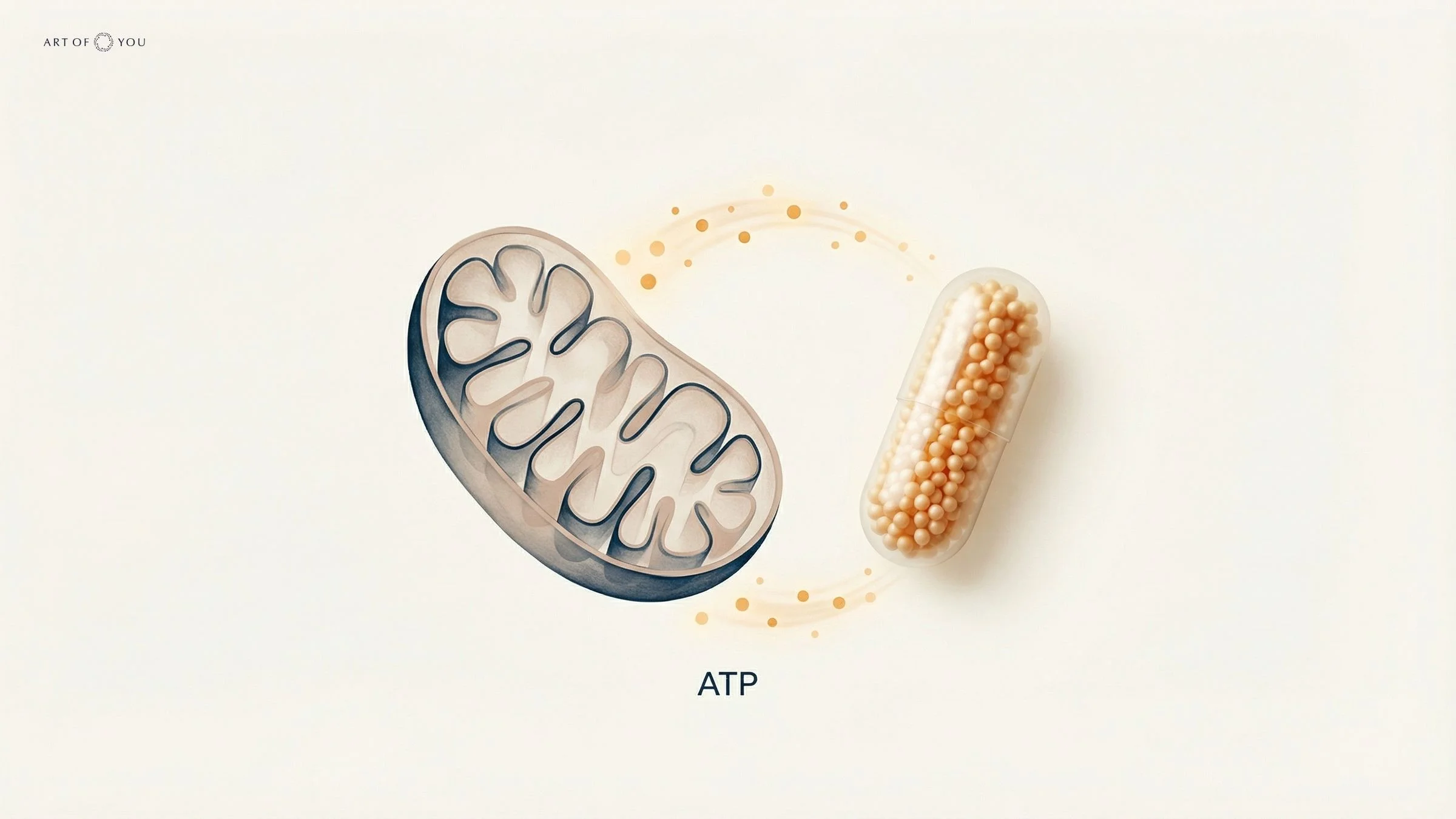
To understand CoQ10's role, you need to understand where energy actually comes from. Your cells generate energy in the form of adenosine triphosphate (ATP) — the universal cellular fuel. This process happens inside the mitochondria, through a series of chemical reactions collectively known as the electron transport chain (ETC).
CoQ10 is not a passive bystander in this process. It acts as a critical electron carrier, shuttling electrons between the protein complexes of the ETC (specifically Complex I and Complex II to Complex III). Without CoQ10 in sufficient quantities, this electron transfer slows, ATP production falls, and cells begin to underperform.
Think of it this way: if the mitochondria are the engine, CoQ10 is the component that keeps the combustion cycle running efficiently.
CoQ10 as an Antioxidant
The same electron-carrying capacity that makes CoQ10 essential for energy also makes it a potent antioxidant. In its ubiquinol form, CoQ10 neutralizes reactive oxygen species (ROS) — the unstable free radicals generated as a natural byproduct of energy metabolism.
This dual role is rare. Most antioxidants simply scavenge free radicals. CoQ10 works at the source, inside the mitochondria, where oxidative stress begins. A 2024 review published in Nutrients confirmed that CoQ10 supplementation improved cellular oxidative status and reduced biomarkers of oxidative stress in multiple clinical populations.
CoQ10 Levels Decline with Age
Here is what most people are not told: your body's ability to synthesize CoQ10 begins to decline from around your mid-20s, and the drop becomes more pronounced after 40. By your 60s and 70s, tissue CoQ10 concentrations can be substantially lower than they were in early adulthood.
A study examining myocardial tissue found significantly lower CoQ10 content in patients over 70 compared to younger adults — directly in the organ most dependent on sustained energy output.
| Age Group | Estimated Relative CoQ10 Level |
|---|---|
| 20s | Peak (reference baseline) |
| 30s | Slight natural decline begins |
| 40s | Moderate decline, ~20–30% lower |
| 50s | Continued decline, especially under physiological stress |
| 70+ | Significantly reduced in cardiac and skeletal muscle tissue |
This age-related decline is compounded for people taking statin medications. Statins work by blocking HMG-CoA reductase — the same enzymatic pathway used to produce both cholesterol and CoQ10. Studies have shown statins can reduce circulating CoQ10 levels by 16% to 54%, depending on the statin and dosage used. A study published in JAMA Neurology found that atorvastatin significantly decreased blood CoQ10 levels in patients at risk for cardiovascular disease.
CoQ10 and Heart Health
The heart is the most metabolically active muscle in the body. It beats approximately 100,000 times per day and has virtually no tolerance for energy deficits. It is also one of the tissues with the highest CoQ10 concentration — which means it is one of the first to register the effects of CoQ10 insufficiency.
The clinical evidence on CoQ10 and cardiovascular support is now extensive. A 2024 systematic review and meta-analysis published on medRxiv, covering prospective cohort studies from 2000 to 2023, found that CoQ10 supplementation was associated with:
- Improved systolic function, measured by a mean increase in ejection fraction of 5.6%
- Improvements in endothelial function and exercise capacity
- Reductions in biomarkers of oxidative stress and inflammation
A separate 2025 meta-analysis of 45 randomized controlled trials, published in PMC, found that CoQ10 administration significantly reduced systolic blood pressure (weighted mean difference: -3.44 mmHg), supporting its role in contributing to cardiovascular wellness.
For people over 50 with an existing cardiometabolic risk profile, these findings are clinically meaningful rather than marginal.
Ubiquinone vs Ubiquinol: Which Form Is More Bioavailable?
One of the most frequently debated questions in CoQ10 research is which form — ubiquinone or ubiquinol — delivers better results.
Here is what the evidence shows:
Ubiquinone is the oxidized, conventional form found in most CoQ10 supplements. After ingestion, it must be converted to ubiquinol by the body before it can be used as an antioxidant. This conversion is generally efficient in younger adults but may become less reliable with age.
Ubiquinol is the reduced, active form. Because it requires no conversion step, it appears in the bloodstream more readily. A crossover study published in RSC Food & Function found that ubiquinol supplementation enhanced plasma CoQ10 concentrations to a greater degree than ubiquinone at equivalent doses. A comparison trial showed plasma CoQ10 rising from 0.9 to 4.3 µg/mL after ubiquinol versus 0.9 to 2.5 µg/mL after ubiquinone over four weeks.
| Feature | Ubiquinone | Ubiquinol |
|---|---|---|
| Form | Oxidized | Reduced (active antioxidant) |
| Conversion required | Yes (body converts to ubiquinol) | No |
| Typical plasma response | Moderate increase | Higher increase (approx. 2x Cmax) |
| Stability in supplements | High | Lower (oxidizes over time) |
| Cost | Lower | Higher |
| Best suited for | Generally healthy adults under 40 | Over 40s, statin users, high-output individuals |
It is worth noting that the research is not entirely one-sided: some studies have found no statistically significant difference in outcomes between forms, and emerging evidence on novel cocrystal formulations suggests that delivery technology may matter as much as the form itself. A key finding from bioavailability research: CoQ10 crystal dispersion in the initial formulation can affect absorption by as much as 75%.
This is why how a supplement is manufactured and delivered matters as much as what it contains.
CoQ10 for Athletes and High-Performers
For people placing significant physical demands on their body — whether through structured training or extended periods of cognitive and executive output — CoQ10 has a specific relevance.
A 2023 systematic review in PMC examining CoQ10 supplementation in athletes found that:
- CoQ10 significantly reduced markers of exercise-induced muscle damage (LDH, CK, and MDA levels)
- CoQ10 contributed to improvements in anaerobic performance and reduction of fatigue markers
- Higher dosages in the 200–300mg range over 4–12 weeks were needed to meaningfully increase muscle tissue CoQ10 content
A 2025 randomized double-blind placebo-controlled trial in professional soccer players published in BMC Sports Science, Medicine and Rehabilitation found that short-term CoQ10 supplementation reduced markers of cardiac stress following heavy exercise.
For corporate athletes — executives and leaders maintaining high cognitive and physical output into their 50s and 60s — this recovery-protective effect is as relevant as it is for trained athletes.
CoQ10 Dosage: What the Research Supports
There is no universally agreed single dose for CoQ10, because optimal intake depends on age, health status, and individual goals. Here is what the clinical literature suggests:
| Use Case | Typical Research Dosage | Notes |
|---|---|---|
| General wellness support | 100–200 mg/day | Consistent with most RCT dosing |
| Cardiovascular support | 200–300 mg/day | Used in heart function studies |
| Statin users | 100–200 mg/day | To offset statin-induced depletion |
| Athletic recovery | 200–300 mg/day (4+ weeks) | Required for muscle tissue saturation |
| Skin and anti-aging | 100–200 mg/day | Per 2023 clinical trial in older women |
A 2023 randomized, double-blind, placebo-controlled trial published in the Journal of the American Academy of Dermatology enrolled women aged 60–76 and found that oral CoQ10 at both 100mg and 200mg per day over 12 weeks contributed to measurable improvements in skin health markers associated with aging, suggesting systemic CoQ10 status has effects well beyond the cardiovascular system.
CoQ10 is fat-soluble, meaning it is best absorbed when taken with a meal containing dietary fat. Splitting a larger daily dose into two smaller doses may also improve plasma levels compared to a single large dose.
CoQ10 in the Art of You Formula
CoQ10 is one of the 29 clinically-studied ingredients in the Art of You personalized supplement formula. It is included precisely because of its central role in cellular energy metabolism and oxidative stress protection — two of the most consistent findings across decades of CoQ10 research.
Because CoQ10 is fat-soluble and notoriously difficult to absorb in standard capsule form, delivery method is critical. Art of You uses a pharmaceutical-grade beadlet technology that encapsulates each ingredient individually, optimizing the conditions for absorption. This is part of the science behind our formula: pharmaceutical-grade manufacturing standards applied to every ingredient, not just the most expensive ones.
If you are unsure whether CoQ10 is the right priority for your personal profile, take the personalization quiz — it maps your goals and health context to the ingredients most relevant to you.
Key Takeaways
- CoQ10 production declines with age starting in your mid-20s, with more pronounced drops by the 40s and 50s — a window when supplementation is most likely to be meaningful
- The heart depends on CoQ10 more than almost any other organ. Clinical evidence consistently links CoQ10 supplementation to improvements in cardiovascular function biomarkers, including ejection fraction and blood pressure
- Statin users face a compounded depletion risk. Statins can reduce CoQ10 blood levels by 16–54%, making CoQ10 supplementation particularly relevant for this population
- Ubiquinol generally shows higher plasma response than ubiquinone at equivalent doses, though delivery technology and formulation quality may be as important as the form itself
- Dosage matters. Research supports 100–200mg for general wellness and 200–300mg for athletic recovery or cardiovascular support — with fat-soluble delivery improving absorption
- You can explore CoQ10 alongside the full ingredient science at our ingredients page
Sources: Crane et al., Biochemical and Biophysical Research Communications (1957); 2024 Systematic Review and Meta-Analysis, medRxiv; Effects of CoQ10 on Blood Pressure, PMC (2025); Ubiquinol vs Ubiquinone Bioavailability, RSC Food & Function; CoQ10 Supplementation in Athletes, PMC (2023); Short-term CoQ10 in Soccer Players, BMC Sports Science (2025); Atorvastatin and CoQ10 Levels, JAMA Neurology; Oral CoQ10 and Skin Aging RCT, JAAD (2023); CoQ10 and Cognition Review, PMC (2025); Comparative Bioavailability of CoQ10 Formulations, PMC (2020)
Art of You products are food supplements and are not intended to diagnose, treat, cure, or prevent any disease.
FAQ
What is CoQ10 and what does it do? CoQ10 (Coenzyme Q10) is a naturally occurring fat-soluble compound found in virtually every cell of the body. It serves two primary functions: acting as an electron carrier in the mitochondrial energy production pathway (supporting ATP synthesis), and functioning as an antioxidant that helps neutralize free radicals, particularly inside the mitochondria.
What are the main CoQ10 benefits? The strongest clinical evidence supports CoQ10's role in contributing to cardiovascular function (including ejection fraction and blood pressure), cellular energy production, recovery from exercise-induced muscle stress, and protection against oxidative damage. A growing body of research also links systemic CoQ10 status to skin health and cognitive support, particularly in older adults.
Who benefits most from CoQ10 supplementation? Four groups stand out in the research: adults over 40 (due to natural age-related decline), people taking statin medications (which deplete CoQ10 via the mevalonate pathway), athletes and high-performing individuals seeking to support recovery, and anyone with elevated cardiovascular risk or high metabolic demand.
What is the difference between ubiquinol and ubiquinone? Both are forms of CoQ10. Ubiquinone is the oxidized form that the body converts to ubiquinol after absorption. Ubiquinol is the already-reduced, active antioxidant form. Clinical comparisons generally show higher plasma CoQ10 levels with ubiquinol supplementation, making it the preferred form for older adults and those with impaired conversion capacity. That said, formulation quality and delivery technology also significantly affect bioavailability regardless of form.
How much CoQ10 should I take per day? Research dosages range from 100mg for general wellness support to 200–300mg for cardiovascular support or athletic recovery. CoQ10 is fat-soluble, so taking it with a meal containing dietary fat meaningfully improves absorption. Splitting a larger dose across two meals can also support more consistent plasma levels.
Does CoQ10 help with energy and fatigue? CoQ10 supports cellular energy production at the mitochondrial level rather than acting as a stimulant. Studies in populations with low CoQ10 status show improvements in perceived fatigue and energy output following supplementation. The effect is most pronounced in those whose CoQ10 levels were below optimal before supplementation began.
Can statin users benefit from CoQ10 supplementation? Statins reduce CoQ10 production via the mevalonate pathway, with studies showing reductions in blood CoQ10 of 16–54% depending on the statin and dose. Some clinical trials have found that CoQ10 supplementation helped reduce muscle-related symptoms (pain, weakness, cramping) associated with statin use, though the evidence is not yet uniform across all studies. People on statins are among the populations most frequently recommended to consider CoQ10 by practitioners.
Is CoQ10 part of the Art of You formula? Yes. CoQ10 is one of the 29 clinically-studied ingredients in the Art of You formula. Given its fat-soluble nature and well-documented bioavailability challenges in standard supplement forms, it is delivered using pharmaceutical-grade beadlet technology that supports optimal absorption conditions. You can explore the full ingredient list at our ingredients page.
How long does it take for CoQ10 to work? Most clinical trials showing meaningful results ran between 4 and 12 weeks. Plasma CoQ10 levels typically begin rising within the first week of supplementation, but tissue-level saturation — particularly in muscle — takes longer and may require higher doses sustained over several weeks.
What are the signs that CoQ10 levels may be low? There is no single definitive symptom of low CoQ10 status, as its effects are systemic. However, persistent fatigue, reduced exercise tolerance, muscle weakness or discomfort (particularly in statin users), and reduced cardiovascular stamina can all be consistent with suboptimal CoQ10 levels. The most reliable way to assess your needs is through a personalized review of your biomarkers and health context — which is precisely what the Art of You quiz is designed to support.